


How Long Is Rotisserie Chicken Good For In The Fridge?
Half a chicken in the fridge can solve tomorrow’s lunch. By the end of the week, though, it can leave you standing at the open door trying to remember when you bought it. Was it Monday, or was that the chicken from last Thursday?
If you’re wondering how long is rotisserie chicken good for in the fridge, keep it for three to four days at 40°F (4°C) or below. That advice assumes you refrigerated it promptly and kept it cold. If it has been there for five days, don’t eat it just because it still smells fine.
Quick answer: How long is rotisserie chicken good for in the fridge?
The USDA advises using refrigerated rotisserie chicken within three to four days. An unopened deli container doesn’t add extra days, and neither does moving the meat into a better box. For a freshly prepared hot chicken, note the purchase date before putting the leftovers away.
| Storage situation | Recommended action |
|---|---|
| Refrigerated promptly at 40°F or below | Eat within 3–4 days |
| In the fridge for 5–7 days | Throw it away |
| Left out for more than 2 hours | Throw it away |
| Left out for more than 1 hour in air above 90°F | Throw it away |
| Safely frozen at 0°F (-18°C) | Use within about 4 months for best quality |
Key takeaways
- Put leftovers away promptly, including while they are still warm.
- Divide a whole hot chicken into smaller portions for cooling.
- Write the purchase date on the container.
- Freeze portions meant for meals beyond the next few days.
- Check reheated chicken with a thermometer; it should reach 165°F (74°C).
Start with the date you bought it
Imagine that you take a hot chicken home on Monday night. You have your dinner, split the remainder, and then get the leftovers into the fridge straight away. Since Thursday night is three days after that and Friday night is four days after, you should aim to eat up the meat that is in the refrigerator by then.
Opening the package on Tuesday doesn’t move that deadline. Nor does taking the meat off the bones on Wednesday. I recommend writing the date straight on a label, because “I’ll remember” is easy to say when you’re clearing up dinner.
If you have bought some chicken from a deli that was cold, check it more carefully since it may have been cooked before you went shopping; in this case, look for the date it was prepared and the storage instructions as well. You should observe the earlier deadline mentioned rather than suppose that all chilled chicken remains good for four more days after you have bought it.
The mistake often happens before the chicken reaches the fridge
It’s easy to buy a hot chicken, stop at another shop, drive home, and leave it out while unpacking the bags. By dinner, it may have spent much longer without temperature control than you realized. A closed lid doesn’t keep it safely hot indefinitely.
Follow the two-hour limit for food that needs refrigeration. In air above 90°F (32°C), the limit is one hour. Include travel and time on the counter whenever the chicken isn’t being kept safely hot or cold.
Buy the chicken near the end of your trip and take it home promptly. If you have a long journey, arrange a way to keep it at a safe temperature. Don’t judge that by touching the outside of the bag or container.
Putting away the leftovers takes only a few steps
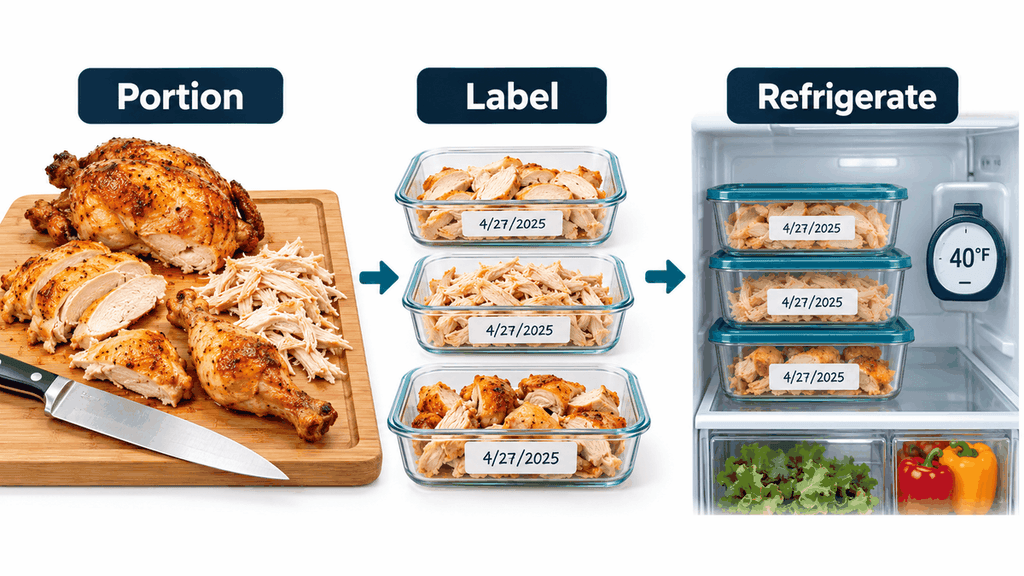
There’s no need to pick the bird completely clean before storing it. Cut off manageable pieces, slice the breast meat, and separate the legs and wings. The aim is to avoid putting a whole hot bird into the fridge as one large mass.
- Wash your hands and use a clean board and knife.
- Divide the chicken into smaller portions.
- Spread those portions into shallow food-safe containers.
- Cover, date, and refrigerate them promptly.
You don’t have to wait until the meat feels cold. USDA guidance for cooling cooked leftovers says hot food can go directly into the refrigerator. Smaller portions and shallow containers help it cool more quickly.
Allow cold air to circulate around the containers. Make sure that the cooked chicken is kept separate from any raw meat and from things that might drip onto it. Instead of judging by how cold the shelf looks, use a fridge thermometer to check that the temperature is at 40°F or below.
Airtight containers help, but they don’t add days
A well-fitting lid helps stop the chicken from drying out. It also protects the food from spills and contact with other things in the fridge. What it doesn’t do is make five-day-old chicken a safe lunch.
Use the same storage limit for meat in an airtight container, a sealed food bag, or its original deli package. Home vacuum sealing isn’t a reason to keep it longer either. Choose a container that suits the portion instead of trying to squeeze extra days out of the packaging.
Keeping the chicken on the bone doesn’t change the limit. Bone-in pieces are fine to store when handled properly, though breaking up a whole bird helps it cool. Remove the bones if that makes your next meal easier, rather than because you expect the meat to last longer.
What about chicken that has been in the fridge for five days?
Throw it away if five full days have passed. The same applies to six days or a week, even when the container has stayed closed. That is beyond the recommended refrigerator storage time for cooked chicken.
You may have eaten older leftovers before without getting sick. That doesn’t tell you whether the chicken in front of you is safe today. You can’t check for every foodborne germ at home, and tasting a small piece isn’t a safe test.
Cooking it again isn’t a reliable fix. The CDC explains that cooking does not destroy the toxin produced by Staph bacteria. So don’t turn questionable chicken into soup, curry, or a casserole to avoid throwing it out.
Why the smell test can let you down
Spoiled chicken may smell sour, feel unusually slimy, or have visible mold. Any of those signs is a reason to discard it, even if you bought it recently. Don’t cut off a moldy area and keep the remaining meat.
But chicken doesn’t have to smell bad to make you ill. Harmful bacteria can be present without changing its appearance or odor. That is why the date and storage history matter more than a quick sniff.
If you can’t remember when it was bought, check whether someone else in the house knows. A receipt or shopping record may help you work it out. If you still can’t establish its age or whether it was kept cold, I would throw it away.
Does the sell-by date give you longer?
A sell-by date is there to help the retailer manage the food on display. USDA guidance on food date labels explains that it tells the store how long to offer the product for sale. It doesn’t replace proper storage at home.
Keep the purchase or preparation date in mind alongside the package instructions. Follow an earlier stated deadline if one applies. A date on the lid can’t make up for an afternoon in a warm car.
Freeze the extra before you forget about it
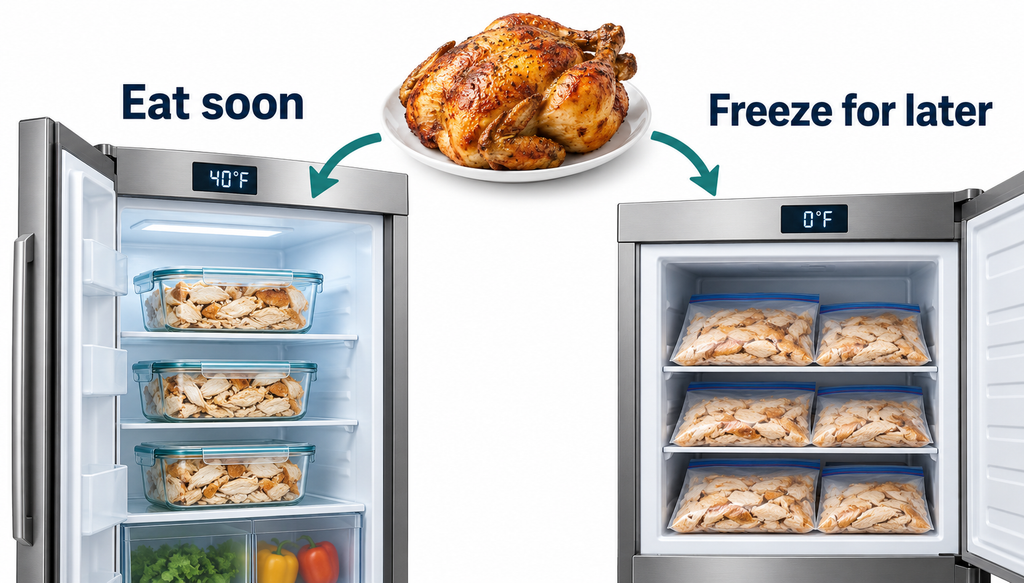
If you only need a few portions, decide what to freeze while you’re putting the chicken away. There’s less to remember later, and you won’t reach Friday with more meat than you can use. Small portions also let you take out just enough for a sandwich, soup, or another meal.
Put the meat into containers or bags which are suitable for use in the freezer. Squeeze out the extra air from the bags, then seal them and put both the date of purchase and the freezing date on them. Make sure that the freezer temperature remains at 0°F (-18°C) or lower.
The USDA recommends using frozen cooked chicken within four months for the best taste. Food that was safe when frozen and stays continuously frozen at the right temperature remains safe longer, though quality can decline. Freezing won’t rescue chicken that was already spoiled or left out too long.
When you need some of it, thaw out a portion in the fridge. According to USDA advice on leftovers, the food can be kept for three to four days after having been thawed in the refrigerator, on the condition that it was handled safely before being frozen. If you thaw it in the microwave, continue heating until the chicken has reached 165°F.
Warm it gently, then check the temperature
Reheat only the portion you want to eat. Add a little water or broth and cover the dish to help keep the meat moist. The important safety check is that it reaches the recommended leftover temperature of 165°F.
Put the pieces evenley into a microwave-safe dish with a vented cover and move or turn them while they are heating, following the instructions regarding the standing time on the appliance. Check a number of places with a thermometer since one hot piece does not indicate that the entire portion is ready.
For oven reheating, use a covered oven-safe dish with a splash of liquid. The time will vary with the amount of meat and its starting temperature. Measure the chicken itself, keeping the thermometer tip away from bone.
Frequently asked questions
Can you eat rotisserie chicken cold?
So, provided that it was well cooked, was put in the refrigerator promptly, and was kept for no longer than the recommended storage time, you can add it directly to a sandwich or a salad and keep that meal in the refrigerator until you are ready to eat it.
Can I freeze the chicken on the fourth day?
So, as long as it is still within the storage period and has been properly refrigerated. If you’re not sure about how it was handled or if you notice any signs of spoilage, don’t freeze it. It’s easier to freeze it earlier, and that way you don’t have to make the decision right at the last minute.
Does making chicken salad give you another four days?
No, mixing in fresh ingredients doesn’t make older chicken fresh again. The official cold food storage chart lists chicken salad at three to four days, but you still need to account for the chicken’s age. Use salad made with older, safely stored leftovers promptly.
How long can you keep the carcass for broth?
Handle it in the same way as the rest of the cooked chicken and get it into the refrigerator immediately. If you are not going to make broth within the time it is stored, then freeze the carcass. It’s not acceptable to keep it in the fridge for a week and then think that boiling will eliminate all the risks.
What if you left the chicken out overnight?
Discard it, even if the room felt cool. Overnight exceeds the usual limit for food that needs refrigeration. Putting it in the fridge the next morning doesn’t undo the hours it spent out.
Conclusion
The answer to how long is rotisserie chicken good for in the fridge is three to four days at 40°F or below, with prompt refrigeration. Keep a date on the container so you know where you stand. If you’re saving some for a meal later in the week, freeze it early.
Next time you bring one home, set aside what you’ll eat soon and freeze the rest in small portions. You’ll have something ready for another meal without having to keep it in the fridge too long. Start with that one habit, and the leftovers become much easier to manage.
Food-safety note: This is general guidance and cannot confirm that a particular chicken is safe. Discard chicken if its age or storage history is uncertain.


